

- Length
- 5'10"
- Width
- 18 9/16"
- Thickness
- 2 3/8"
- Volume
- 25.5 L
Used boards from shops, rental fleets and surfers flying home, searchable by volume, length, shape and condition. Pick the litres you need and message the seller on WhatsApp. Listing a board before you fly home starts with one photo, and there is no fee.
Tell us your weight and how you surf, and we give you the litre range that fits, then show the boards in Bali that carry it. Volume decides whether a board paddles for you. Length, width and thickness decide how those litres are arranged, and they come second.
One photo, and whatever you can say about the board. Talk, type, or paste what you already wrote on Facebook. We read the photos and work out the dimensions, the volume and the damage, then you check every field before it goes live. Listing a board is free.
The boards are already out there, on Facebook Marketplace, in a few buy-and-sell groups and on the rack at the back of a rental shop. None of it can be searched, and the one number that decides whether a board floats you is the one that is never written down. Here volume is a filter, a board that sold says so, and the seller is one WhatsApp message away.

By volume, length, shape and condition. Volume in litres decides whether a board paddles for you, so it is the first filter here and not the last line of a spec list.
Length, width, thickness and volume sit on the card. A number the seller left out shows as missing, and an estimated volume is labelled as one. The listing adds the condition and what is wrong with the board, and marks every figure nobody confirmed.
One tap to WhatsApp. We take no cut and never see the money. You meet the seller, check the board, and pay them directly.
A 10-minute inspection that finds the problems worth walking away from: water in the foam, delamination, buckles, and repairs that were done badly.
5 minute read
What surfboard volume measures, why two boards of the same length can differ by more than double, and how many litres you need for your weight and level.
4 minute read
Shortboard, fish, groveler, twin fin, step-up, midlength, funboard, longboard and soft top: what each type of surfboard is for, how long it is and who it suits.
9 minute read
Surf camp, surf school or a board of your own: what each gives you, where beginners learn in Bali, what a lesson costs, and which board to ride after the lessons.
4 minute read
Most people start with a length, because a length is what a board is called. It is the least useful of the three numbers. Two boards can both be 5'10" and be twenty per cent apart in float, which is the difference between catching waves on a slow morning and watching them go under you.
The number that decides it is volume, in litres, and it comes from your weight and how you surf rather than from your height. A rider at 75 kg who is still learning wants something near their own body weight in litres. The same rider three years later, surfing the open face, wants roughly half of that. Nothing about their height changed.
Get the litre range first, then use length, width and thickness to decide how those litres are arranged. That order is the whole method, and it is the order the volume finder further up this page works in.
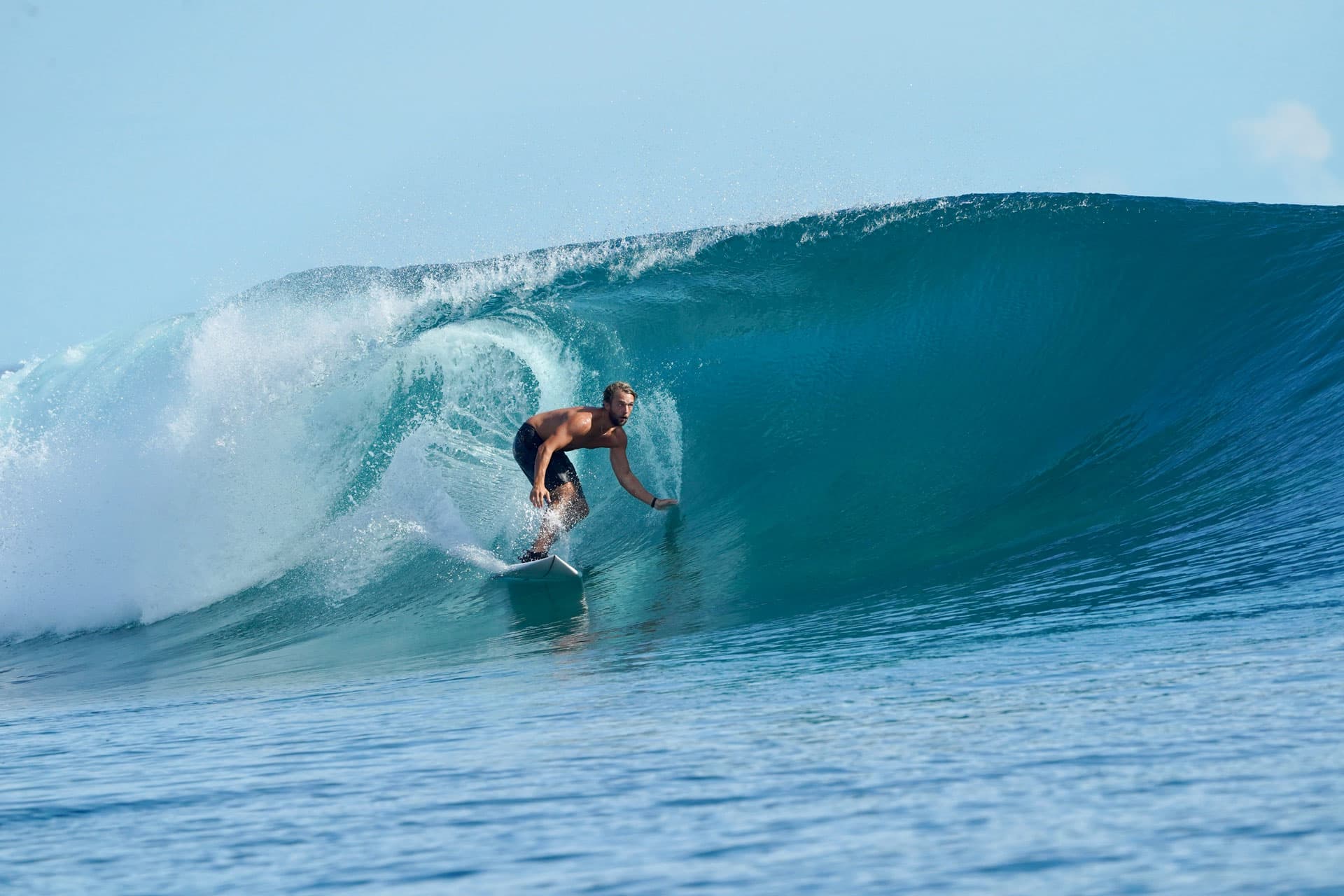
Length is not useless, it is just second. It sets how early the board starts moving when a wave lifts it, and how much room you have to move your feet once you are up. Longer paddles in sooner and holds a line; shorter turns in a tighter space and takes more speed to work.
The bands overlap on purpose. Somebody at 90 kg reading the second row is looking at a different board from somebody at 60 kg reading the same row, and the litres are what tell them apart.
Width is measured at the widest point and is usually written in inches and eighths, as in 19 ¼". More width is more planing surface, so the board sits higher and gets going in weaker waves. It also makes the board slower to roll from one rail to the other, which is why a wide board feels stable in a straight line and stubborn in a turn.
Thickness is measured at the thickest point, usually near the middle of the stringer. More thickness is more float under your chest while you paddle, which is what actually gets you into the wave. It is also the measurement people quietly add when they want more volume without admitting to a wider board, and it is the one that most changes how a board feels when you try to sink the tail.
Two boards at the same volume can put those litres in completely different places. Foam spread wide and thin under the chest paddles well and turns off the rail; foam kept narrow and thick sits deeper and holds in steeper water. That is why the litre number is a starting point and not the whole answer, and why it is worth reading the width and thickness on a listing rather than only the length and the volume.
The tail decides how the back of the board releases. A wider, squarer tail holds more area behind your back foot, so it keeps speed in a slow section and pivots sharply. A pulled-in tail sinks more easily, which is what you want when the wave has real push and you need the board to hold rather than skip.
Fins matter less than the outline and they are the one part you can change after you buy. A thruster is the safe default. A twin is faster in a straight line and looser through a turn. Before you buy a used board, check which fin system it takes and whether the fins are included, because a set is a real cost on top of the board and the boxes are not interchangeable.
A board is chosen against a specific set of waves, and the honest version of that question is not what you hope to surf. It is what you will be surfing most mornings on this trip.
Bali gives you two coasts and a season that decides which one works. The west coast beach breaks are sand-bottomed and forgiving, and most of the year they are where a visitor surfs. The reefs on the Bukit are a different proposition: the take-off is steeper, the water is shallower, and a board that felt fine at a beach break can feel like too much foam the moment the wave stands up.
If you are here for two weeks and most of your sessions will be waist to head high on sand, size for that. Buying the board you want for the one big day costs you the other thirteen. If you already know you are going to the reef, that is the case for a second, narrower board rather than for one compromise board that does neither well.
Shape is the name for how those litres are distributed, and it is the fastest way to narrow a search once the number is settled. Four cover most of what a visitor to Bali is choosing between.
The other five, from the groveler to the longboard, are in the guide to every type of surfboard, drawn to one scale.
A surfboard loses most of its resale value in its first year and then holds fairly steady, so a two year old board in sound condition is the best value on the island by some distance. That is true anywhere. What is specific to Bali is why the boards are for sale.
Most of the supply here is leaving. A board is usually being sold because its owner is flying out, not because they are upgrading, and a flight date is a deadline the seller feels and the buyer does not. It is also the reason this site asks sellers when they leave and shows it on the listing, which no other listing site asks for.
The trade-off is that you are buying a board nobody has inspected for you. SurfPoint takes no payment and handles no shipping, so the ten minutes you spend with the board in your hands is the whole of the quality control. It is enough, if you know what you are pressing on.
Every sizing table asks how you surf, and almost everybody answers one step above where they are. It is the single most expensive mistake in this whole process, because the answer moves the litre range by more than any other input.
A useful test is what happens on an ordinary day rather than on your best one. If you are still mostly in whitewater and standing up is the hard part, you are a beginner and you want a lot of foam. If you get to your feet nearly every time and are learning to angle along the wave instead of straight to the beach, you are improving, and you are not yet the person the shortboard tables are written for. If you ride the open face, turn off the bottom and pick your own sections, you are intermediate, and you can start taking litres away.
Underestimating yourself costs you very little. A board with a few litres too many is easy to surf and easy to sell on. A board with a few litres too few costs you the waves you would have caught, and nobody improves by not catching waves.
Put your weight and your level into the volume finder further up this page and note the range it gives you. Take the low end and the high end, not the middle: the range is the answer, and a board anywhere inside it will work.
Then filter by that range rather than by shape, at least at first. It is the fastest way to find out what actually exists on the island in your size, and it turns up boards you would not have searched for by name. Message the seller, arrange to meet, and take ten minutes with the board before you agree a price.
SurfPoint covers Bali and nothing else for now. If you want boards where you are, or you run a shop and want your stock listed for free, say so and I will tell you when it is worth your time.


Grade 1 · as new · Ungasan